


 OEM Support for Candle Jar Buyers
Glavique Candleware supports custom and OEM candle jar projects for candle brands, contract fillers, importers, wholesalers, packaging suppliers and retail programs. Our core in-house production is glass candle jars, while selected tin and ceramic containers are coordinated through long-term partner factories under Glavique specification, quality control, packing and export management.
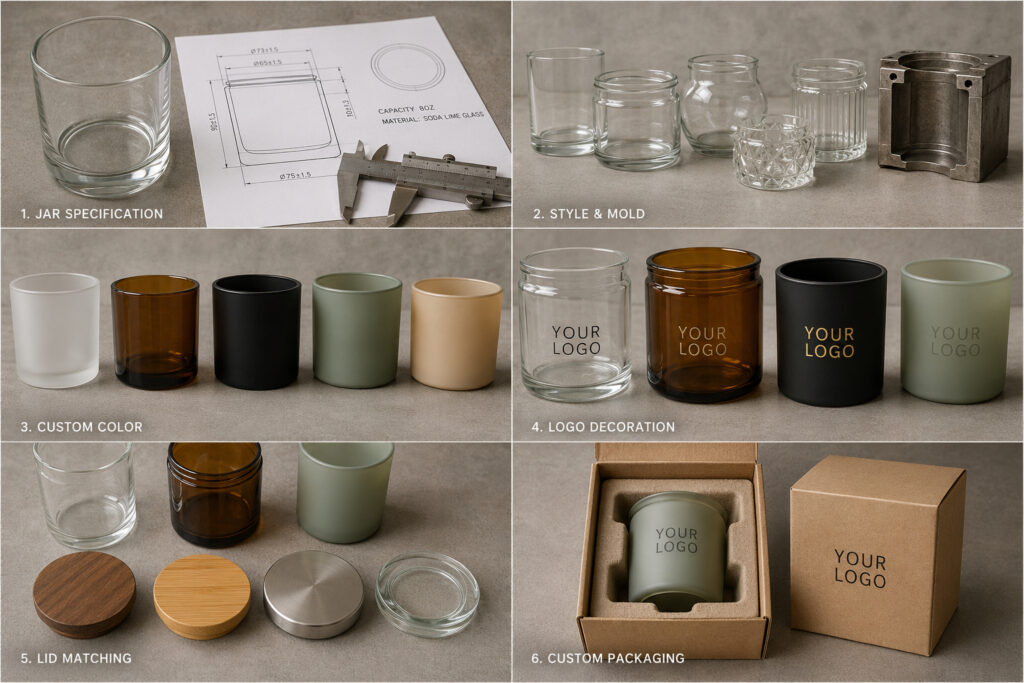
A custom project normally begins with the container itself: material, capacity, dimensions, opening, finish and expected order quantity. Logo decoration, matched lids, labels and branded packaging are then developed around the selected jar.
We supply empty candle containers rather than filled scented candles. Wax formulation, wick selection and final burn-performance validation remain the responsibility of the candle manufacturer or filling company.
Start with the Jar Specification
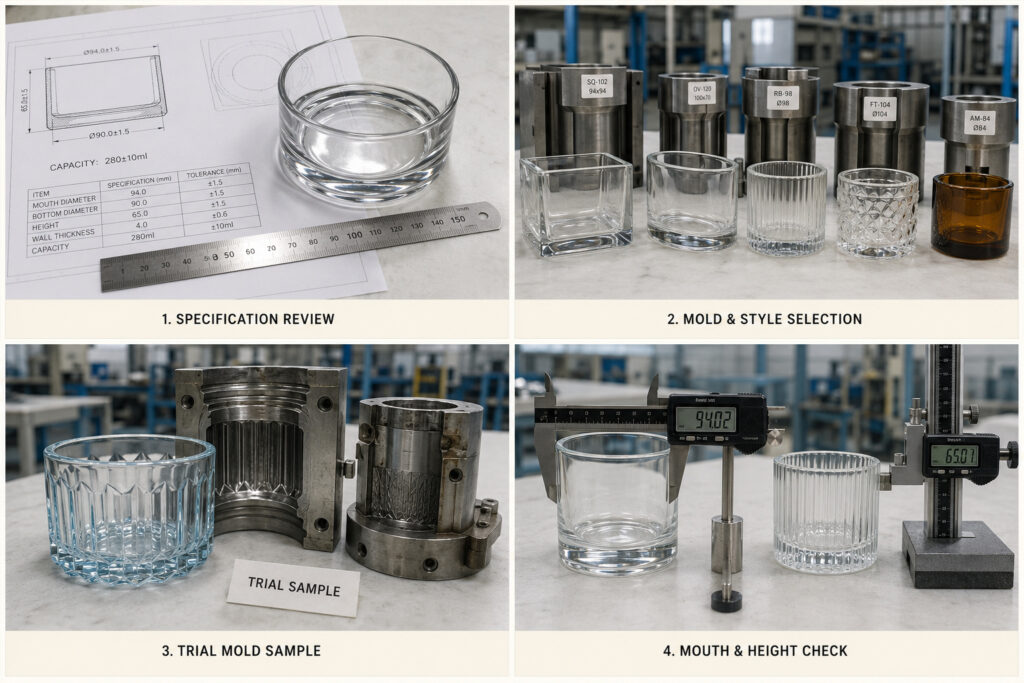
Existing molds are usually the most practical route for trial programs, standard wholesale orders and projects requiring shorter sample development. Buyers should confirm the required capacity, overall height, outside diameter, opening diameter and preferred lid before selecting a model.
A reference photo is useful, but dimensions and intended filling volume are still needed for an accurate comparison. Buyers should also confirm the quantity required for each size, color or SKU because this can affect mold selection, finishing setup, MOQ and pricing.
Glass is Glavique’s core in-house material. Tin and selected ceramic options are available through managed partner production. Material selection should be based on the required appearance, weight, filling method, order volume and packaging plan—not treated as an unrestricted change to the glass composition.
The material and jar specification guide explains the information needed before quotation and sampling.
Custom Size, Shape and Mold Development
When an existing jar does not meet the target capacity, opening or brand profile, Glavique can evaluate a new mold from a drawing, dimensional specification or physical reference sample. The review covers jar geometry, capacity, height, diameter, opening, lid compatibility, tooling requirements and expected project volume.
New mold development affects tooling cost, MOQ and lead time. A drawing or visual rendering alone is not sufficient for production approval. Trial samples must be checked for dimensions, forming condition, appearance and lid fit before the mold is released for customized bulk production.
Buyers considering a proprietary shape can review the custom size and mold development process.
 Colors and Surface Finishes
Frosting, spray coating, matte finishes and selected metallic or decorative effects can be developed against a Pantone reference, buyer-supplied sample or approved color standard. The finish must be evaluated on the actual jar because glass color, coating thickness, surface texture and curing conditions can affect the final appearance.
A physical sample is normally used to confirm color, transparency, gloss level, coverage and surface feel. For multi-SKU programs, buyers should provide the quantity per color because color changes and finishing setup can affect MOQ, unit cost and production scheduling.
More process-specific information is available on the custom colors and surface finishes page.
Logo, Lids and Private-Label Details
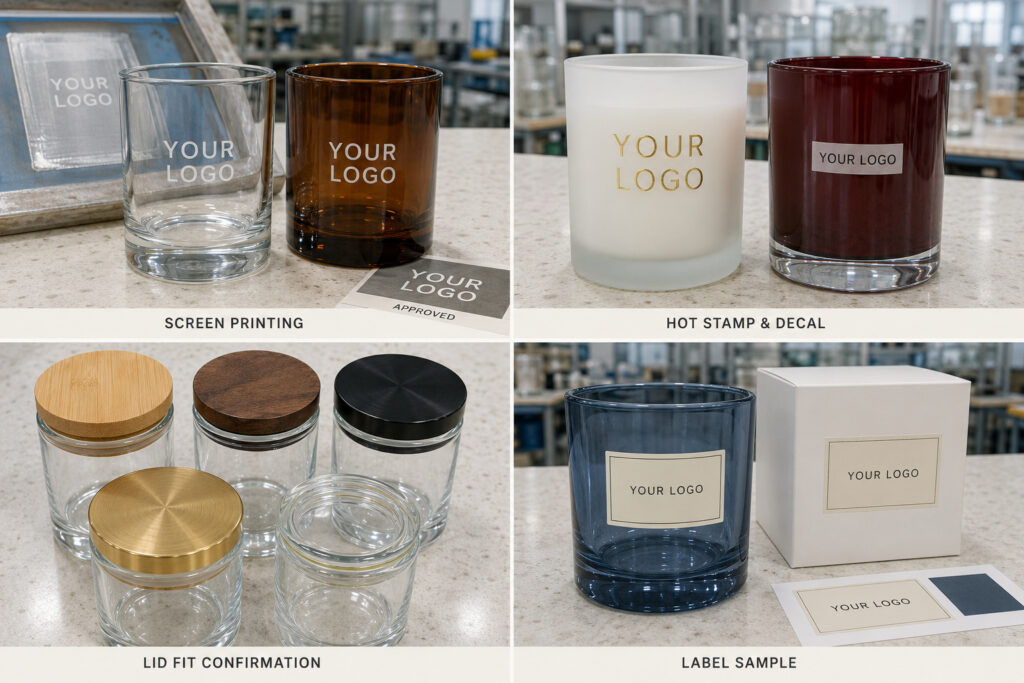
Custom logo options include silk-screen printing, decal and hot stamping, depending on the jar surface, artwork, number of colors and required effect. Buyers should provide vector artwork, logo dimensions, print colors and the intended position.
Curved surfaces, limited printing areas and complex multi-color graphics may require artwork adjustment before sampling. The decoration method should be selected according to the jar finish rather than appearance alone.
Wood, bamboo, metal and glass lids can be matched to the selected jar opening. Lid fit, sealing-ring structure, finish and logo treatment should be approved together with the jar rather than confirmed separately.
Private-label support applies to empty candle containers, lids, labels and packaging. It does not imply candle filling, fragrance development or finished candle production.
 Custom Packaging for Retail and Export
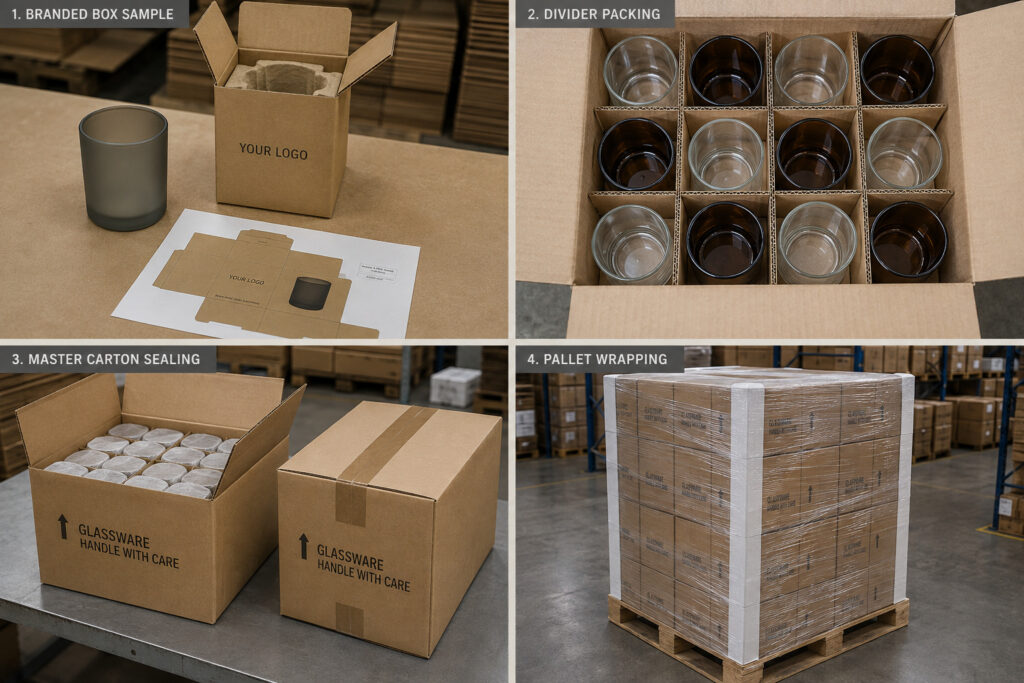
Packaging must address two different requirements: brand presentation and transport protection. Available options can include labels, individual printed boxes, inserts, paper dividers, inner cartons, master cartons, shipping marks and pallet packing.
The packaging structure is selected according to jar weight, surface finish, lid type, shipment method and destination. Matte, coated and decorated jars may require individual separation to reduce rubbing or scratches. Packaging samples, carton checks or drop-test arrangements can be included when required by the order specification.
Detailed options are covered on the custom candle jar packaging page.
 Sample Approval and Bulk Production
Existing samples normally take around 3–7 days. Customized samples usually require approximately 7–15 days, depending on the color, decoration, lid and packaging. New mold projects require a separate tooling and trial schedule.
Before bulk production, the approval sample should confirm:
- Jar dimensions and capacity
- Color and surface finish
- Logo size, position and appearance
- Lid fit and accessory details
- Packaging structure and printed artwork
Standard glass jar orders usually start around 1,000–3,000 pieces. Custom colors, logos or packaging commonly start around 3,000–5,000 pieces, subject to the jar, process and quantity per SKU.
Regular production is generally 25–35 days after approval. Complex finishes and new mold projects may require around 35–45 days. Production timing begins after the sample, artwork and order specifications have been approved.
Information Required for an OEM Quote
For an accurate quotation, send the jar reference or drawing, target capacity and dimensions, quantity per SKU or color, finish, logo artwork, lid type, packaging requirements, destination and required delivery date.
Please also identify any testing, inspection or trade-term requirements. Glavique will then confirm:
- Whether an existing mold or new tooling is appropriate
- Which customization processes are feasible
- Expected MOQ and sample costs
- Sample-development route
- Bulk-production lead time
- Inspection requirements
- Export-packing and shipping options