


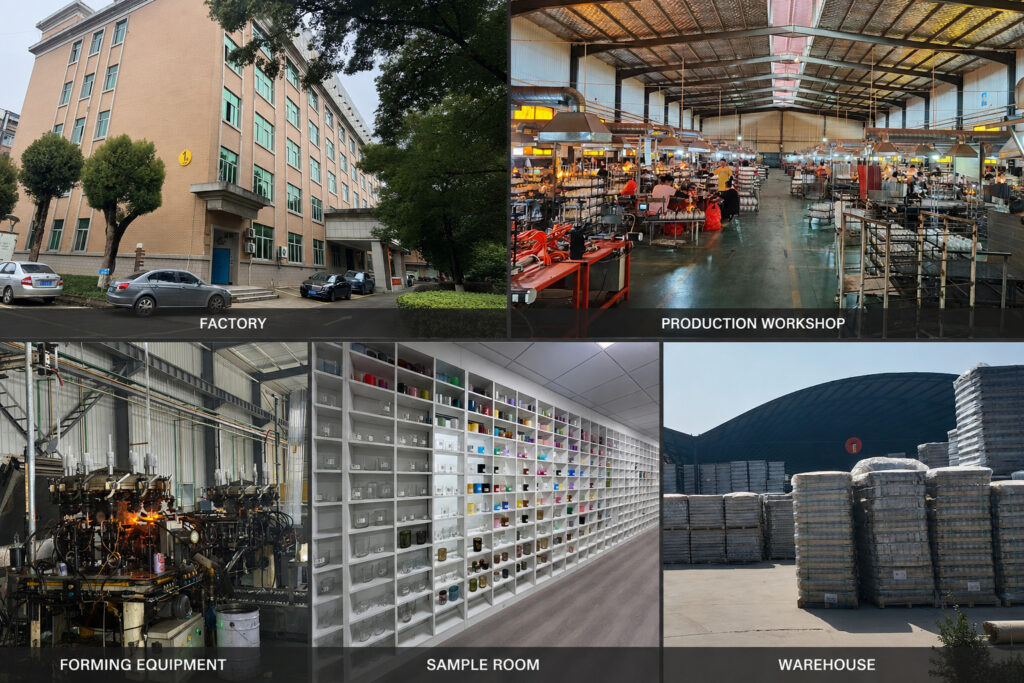
 Manufacturing Scope at Our Xuzhou Factory
Glavique Candleware operates a 19,800 m² manufacturing base in Xuzhou, Jiangsu, focused on glass candle jar production, finishing and export-order handling. Around 160–180 employees support six main glass forming, annealing, surface finishing, decoration, inspection and packing lines.
Our core in-house range includes clear, frosted, amber and matte glass candle jars for candle brands, importers, wholesalers, packaging suppliers and retail programs. Selected tin and ceramic candle jars are produced by long-term partner factories and managed by Glavique for specification confirmation, inspection, packing and export coordination. They should not be understood as products manufactured on the same glass production lines.
Typical monthly output is approximately 2.5–3.5 million glass candle jars across standard and decorated programs. Actual scheduling depends on the jar specification, finish, quantity per SKU, packaging requirements and approval status.
From Jar Specification to Production Planning
Manufacturing starts with a confirmed product specification rather than a general product photo. The buyer should provide the target capacity, height, diameter, opening size, order quantity, preferred finish, logo method, lid, packaging and destination.
Our team first checks whether an existing mold can meet the required dimensions and capacity. A new shape is reviewed for geometry, mold feasibility, tooling requirements and expected project volume. Detailed information about this stage is available on our Glass Forming & Mold Production page.
Existing samples are normally prepared in approximately 3–7 days. Customized samples generally require around 7–15 days, depending on the color, decoration, lid and packaging. A physical approved sample is normally used as the production reference before a customized bulk order begins.
Glass Forming and Mold Control
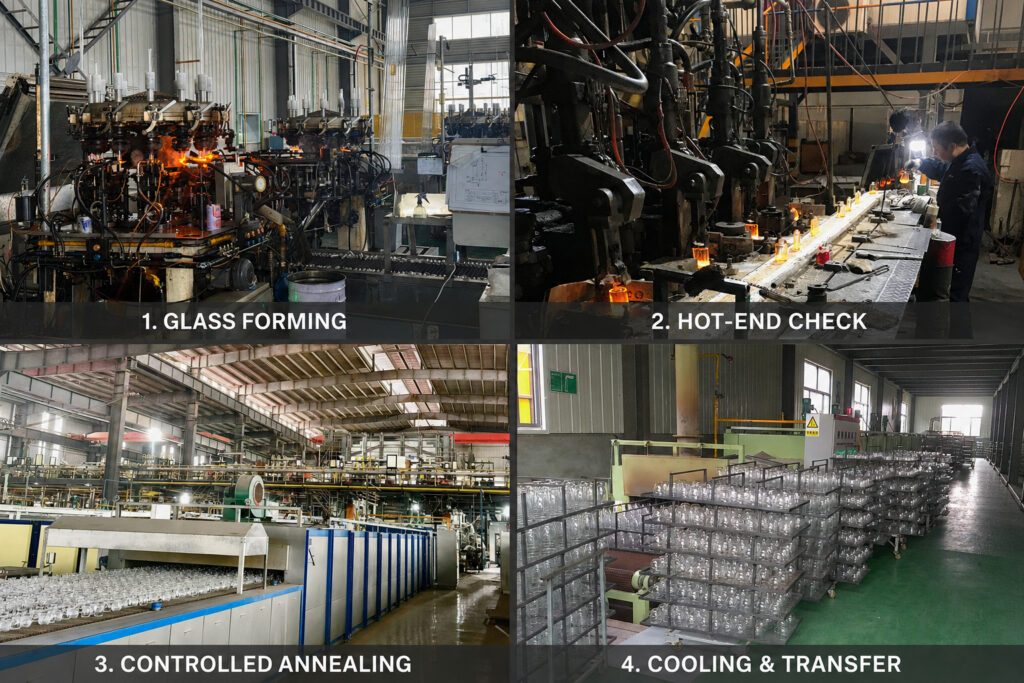
Glass forming determines the main jar structure, including wall distribution, opening dimensions, base condition and overall shape. During production, the selected mold and forming settings must remain suitable for the approved jar specification.
Checks at this stage focus on visible forming defects, critical dimensions, rim condition and whether the jar can proceed to annealing and downstream finishing. For lid-matched programs, the opening diameter and rim structure require particular attention because dimensional variation may affect lid fit or sealing-ring performance.
New mold programs require more development time than orders based on existing molds. Buyers should allow sufficient time for mold trials, dimensional checks, capacity confirmation and sample approval before committing to a fixed launch or shipping date.
 Annealing and Controlled Cooling
Freshly formed glass jars must pass through a controlled annealing and cooling stage. The purpose is to reduce internal stress created during forming and cooling, helping the jar maintain structural stability during later decoration, packing and normal candle-container use.
Cooling that is too rapid or uneven can increase the risk of stress-related breakage. Production checks therefore consider annealing condition together with appearance and dimensions. Annealing-stress or thermal-shock testing can be arranged when required by the buyer specification, target market or intended application.
The Annealing & Cooling page explains the production risks and checks associated with this stage in greater detail.
Frosting, Coating and Surface Finishing
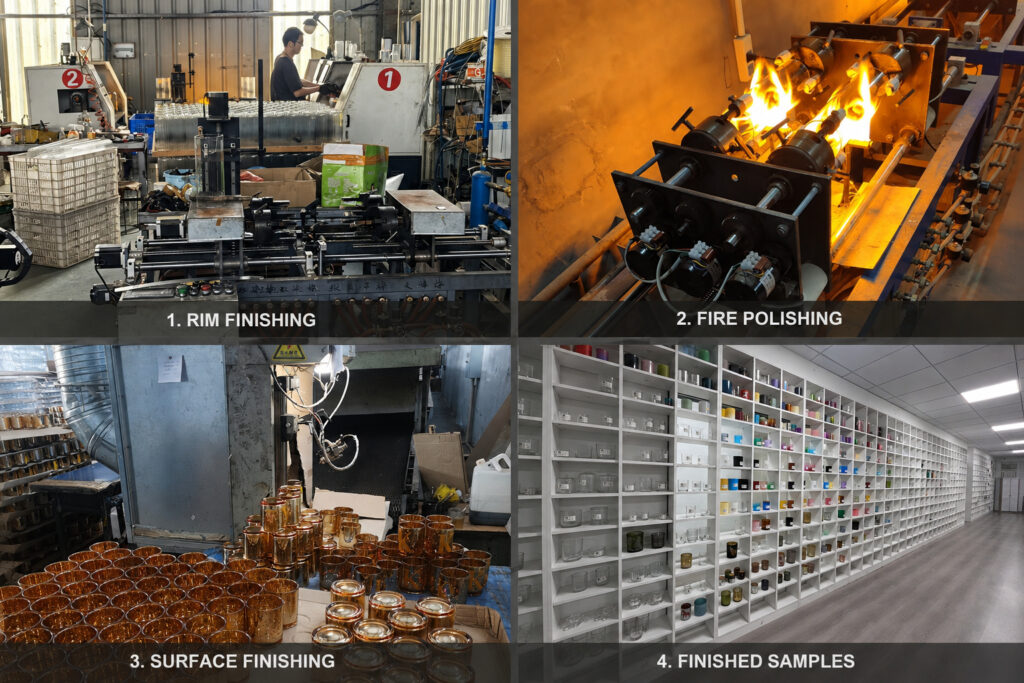
After forming and annealing, jars may remain clear or proceed to frosting, spray coating, matte finishing, electroplating or selected decorative effects. The required finish is confirmed against artwork, a color reference or an approved physical sample.
Surface finishing affects production cost, MOQ and lead time because different colors and effects require separate preparation, processing and inspection. Pantone references can support color development where applicable, but the approved physical sample remains the practical standard for bulk-production comparison.
Inspection at this stage covers surface coverage, visible marks, color consistency, gloss or matte effect and the condition of the rim and base. More complex effects may require additional trials before production scheduling is confirmed.
 Logo Decoration and Component Matching
Silk-screen printing, decal application and hot stamping can be selected according to the jar surface, artwork and required visual effect. Before production, we confirm the logo dimensions, printing area, position, color and orientation.
Bulk inspection compares decoration with the approved sample for clarity, placement, adhesion and consistency. Wood, bamboo, metal or glass lids are also checked against the jar opening. Lid fit should be confirmed with the actual production jar rather than evaluated only from nominal dimensions.
For process-specific considerations, buyers can review our Logo Printing & Decoration page.
Inspection During and After Production
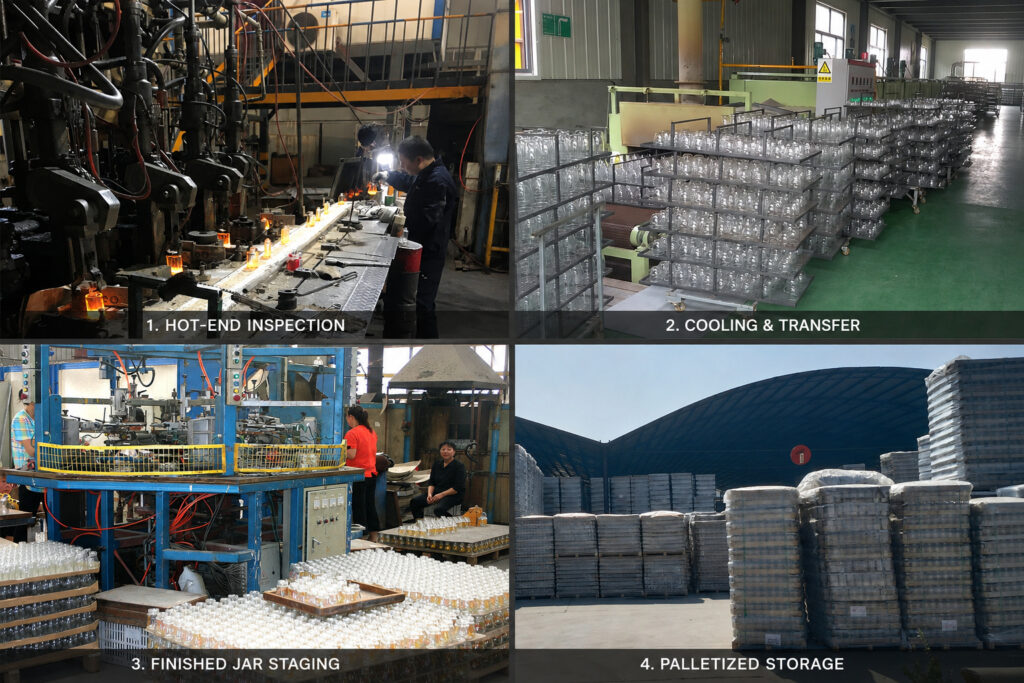
Quality control is performed at relevant production stages instead of relying only on a final carton check. Routine inspection points include forming quality, dimensions, rim and base condition, surface appearance, color consistency, logo position, lid fit, quantity and packaging.
The approved sample, confirmed artwork and order specification provide the main comparison references. Annealing-stress, thermal-shock, food-contact, heavy-metal or packaging testing can be arranged through SGS or another third party when required for a specific product or market.
Inspection requirements that exceed routine production checks should be stated before quotation because additional sampling, testing or documentation may affect cost and timing.
Export Packing and Shipment Preparation
Glass candle jar packing is selected according to jar weight, shape, surface finish, lid configuration and transportation route. Common arrangements include individual protection, paper dividers, inner cartons, master cartons and pallet packing.
Before shipment, checks cover carton quantity, shipping marks, carton condition and pallet protection. Corner boards, strapping and stretch film may be added for palletized orders. Packaging or drop-test arrangements can also be discussed when a buyer has defined handling or distribution requirements.
The Export Packing & Palletizing page provides further information about breakage protection and export preparation.
 Information Required for Manufacturing Review
For an accurate production assessment, send a reference photo or drawing, target capacity and dimensions, quantity per SKU, color or finish, logo artwork, lid choice, packaging style and destination.
Regular bulk production is generally around 25–35 days after approval. Complex finishes or new mold projects may require approximately 35–45 days. Final MOQ, sample timing and production lead time are confirmed after the complete specification has been reviewed.