


Forming Starts With a Confirmed Jar Specification
Glass forming establishes the basic structure of a candle jar, including its capacity, height, diameter, opening, wall distribution and base profile. These details affect lid compatibility, filling-line use, decoration, packing and the appearance of the finished candle.
Before reviewing a project, we need a reference photo, technical drawing or physical sample together with the target capacity and key dimensions. Buyers should also provide the expected quantity per SKU, preferred glass color, lid type and intended surface finish.
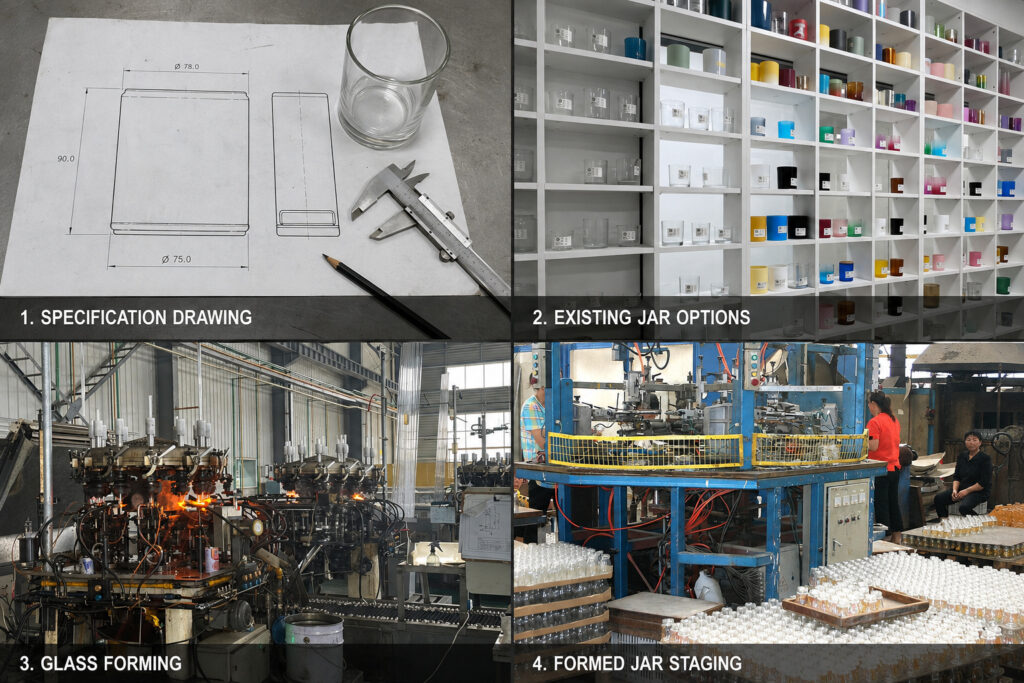
Our team first checks whether an existing mold can meet the specification. Existing molds usually reduce tooling cost and shorten sample preparation. If the required shape, opening or capacity is not available, the project moves to a new mold feasibility review.
Existing Mold Selection
An existing mold is usually the practical starting point for standard wholesale orders, trial programs and projects with a limited development schedule. Available jar shapes can be compared by nominal capacity, height, body diameter, opening diameter and lid compatibility.
A catalog image alone is not sufficient for final selection. Similar-looking jars may have different internal capacities, base thicknesses or openings. Buyers using an automatic candle-filling or labeling line should share any dimensional restrictions before sampling.
Standard existing samples are generally prepared in approximately 3–7 days, subject to sample availability. Colors, finishes and decoration can then be developed after the basic jar structure has been approved.
For a broader review of size and tooling options, see Custom Size & Mold Development.
 New Mold Feasibility and Tooling Review
A new mold may be considered when the project requires a proprietary shape, non-standard dimensions, a specific capacity or an opening that must match a selected lid.
The review covers jar geometry, target wall and base structure, mold construction, production feasibility and expected order volume. Shapes with sharp transitions, complex patterns or unusual proportions may require adjustment before tooling. This helps avoid designs that are difficult to form consistently or unsuitable for repeat bulk production.
Tooling cost, development time and MOQ are confirmed only after the drawing and project requirements have been reviewed. New mold development should not be scheduled against the same timeline as a standard existing-mold order.
Glass Forming and Hot-End Checks
During forming, molten glass is shaped through the selected production mold. The forming stage must control the main jar profile, opening, rim, wall distribution and base condition before the jars continue to annealing.
Hot-end checks focus on visible forming defects and obvious structural variation. Typical concerns include an uneven rim, distorted body, unstable base, excessive glass concentration and inconsistent dimensions. Jars that do not meet the required forming condition should be separated before downstream finishing adds further production cost.
After forming, jars pass through controlled Annealing & Cooling to reduce internal stress before decoration, inspection and packing.
Trial Samples and Dimensional Confirmation
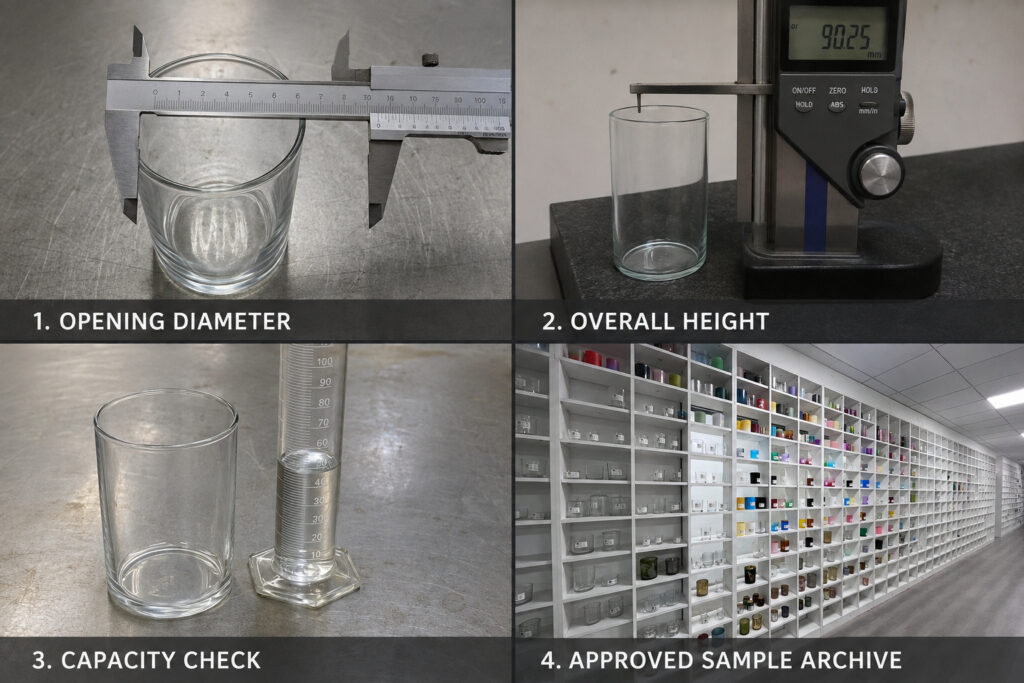
New mold trials provide physical samples for checking the jar against the approved drawing. Key confirmation points normally include overall height, body diameter, opening diameter, capacity, rim condition, base stability and general appearance.
Lid fit should be checked using the intended lid and sealing component rather than relying only on nominal opening dimensions. If the jar will use a label, printed logo or full-surface finish, the available decoration area should also be confirmed at this stage.
A trial may require adjustment before the mold and jar specification are approved. Buyers should complete structural confirmation before investing in custom colors, logo decoration or branded packaging.
 Sample Approval Before Bulk Production
The approved physical sample becomes the practical reference for customized bulk production. It should record the confirmed dimensions, capacity, glass appearance and lid fit, together with any accepted manufacturing tolerances.
Later finishing requirements can be developed through Custom Colors & Surface Finishes and Custom Logo & Decoration. These processes should follow structural approval because coating, printing and packaging cannot correct an unsuitable jar shape or opening.
Information Needed for a Mold and Forming Quote
Send the following information for an accurate review:
- Jar drawing, reference photo or physical sample
- Target capacity, height, diameter and opening size
- Quantity required for each design or SKU
- Preferred lid and sealing-ring requirements
- Glass color and intended surface finish
- Logo or decoration area
- Destination and required project schedule
Regular bulk production is generally around 25–35 days after approval. New mold projects or complex specifications may require approximately 35–45 days, excluding any additional time needed for drawing revision, tooling trials or repeated sample confirmation.