


Why Annealing Matters in Candle Jar Production
Newly formed glass candle jars leave the forming stage at a high temperature. If they cool too quickly or unevenly, internal stress may remain within the glass structure. This can increase the risk of cracking or breakage during surface finishing, packing, transportation or normal candle-container use.
Annealing uses controlled heating and gradual cooling to reduce this internal stress. It is a standard production stage between Glass Forming & Mold Production and downstream finishing or decoration.
The annealing requirement depends on the jar shape, wall distribution, base thickness and production condition. A heavier base or uneven glass distribution can require particular attention because different parts of the jar may cool at different rates.
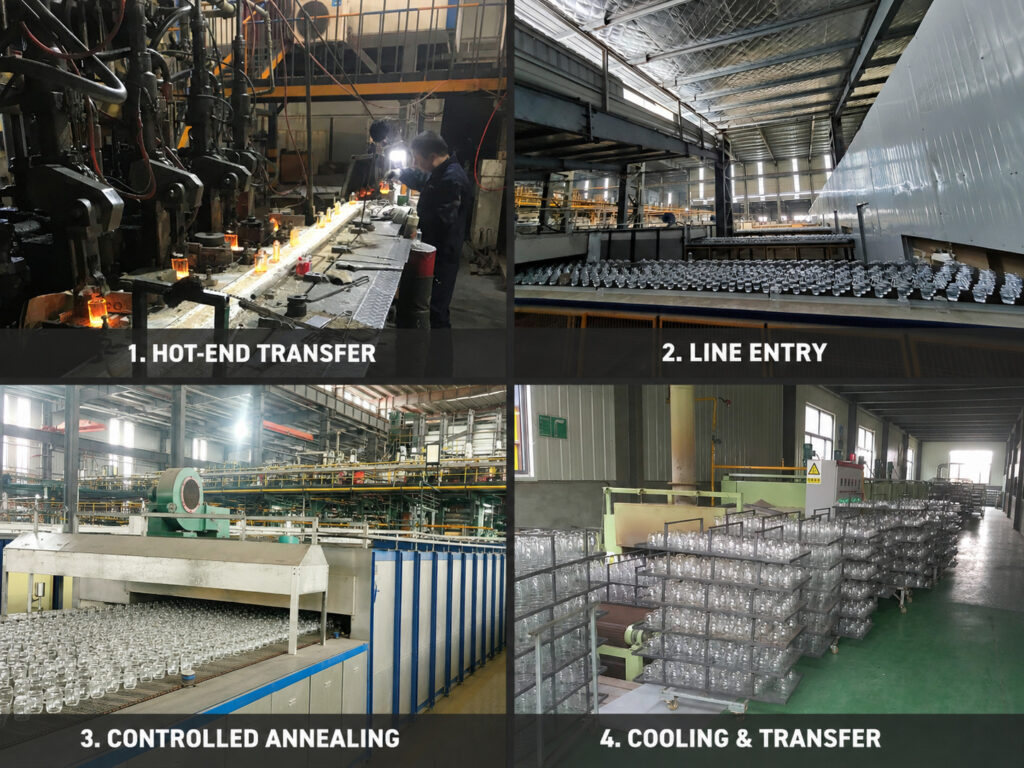
Transfer From Forming to the Annealing Line
After forming and initial hot-end checks, jars are transferred to the annealing conveyor. The transfer should be continuous and controlled so that the containers do not experience an abrupt temperature change before entering the annealing section.
At this stage, visibly distorted jars, damaged rims or other obvious forming defects can be separated. Removing unsuitable jars early prevents unnecessary finishing, decoration and packing costs later in production.
The arrangement of jars on the conveyor also matters. Sufficient spacing helps maintain stable movement through the line and reduces contact between hot containers.
 Controlled Heating and Gradual Cooling
The annealing line moves formed jars through controlled temperature zones. The jars are maintained and cooled gradually rather than being exposed immediately to normal workshop temperature.
Production settings must be appropriate for the selected jar structure and line speed. Cooling that is too rapid may leave internal stress, while unsuitable handling can affect production efficiency and jar stability. The purpose is not simply to make the jars cold; it is to bring them down to a manageable temperature under controlled conditions.
Annealing does not correct an incorrectly formed jar. Problems involving an uneven rim, distorted shape, unstable base or excessive dimensional variation must be addressed during forming and mold control.
Post-Annealing Cooling and Transfer
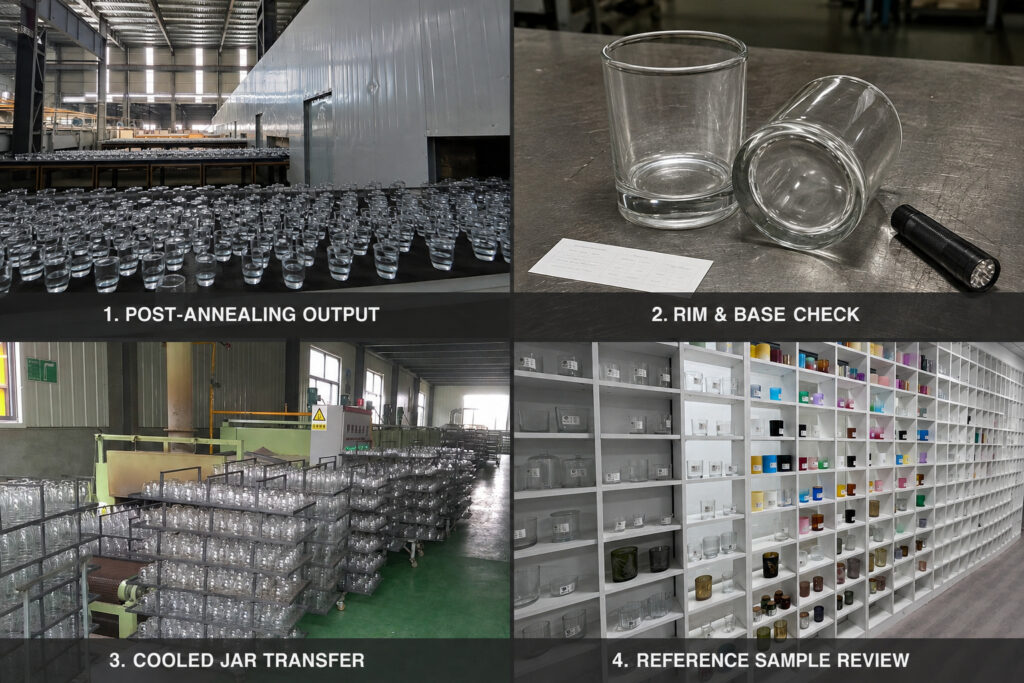
After leaving the annealing section, jars continue cooling before they are moved to finishing, inspection or temporary staging. Metal racks and transfer systems are used to organize the jars and reduce uncontrolled contact during handling.
The jars should be cool enough for downstream operations such as frosting, spray coating, printing or packing. Moving them too early may affect handling safety or the consistency of subsequent processes.
For decorated OEM orders, jars proceed to Frosting & Surface Finishing only after the base glass production stage has been completed and the jar condition is suitable for further processing.
Checks After Annealing
Routine post-annealing checks may cover visible cracks, rim condition, body shape, base stability and obvious surface defects. Jar dimensions and appearance are also reviewed at relevant inspection stages according to the approved specification.
Annealing-stress or thermal-shock testing can be arranged when required by the buyer, intended product use or destination-market specification. Testing requirements should be provided before quotation because the method, sampling plan and third-party involvement may affect cost and timing.
The Quality Inspection & Testing page explains the broader checks used during customized and bulk candle jar programs.
 Factors Buyers Should Confirm Before Production
Annealing parameters are handled during factory production, but buyers should still provide information that affects the finished jar requirement:
- Intended use as an empty candle container
- Jar dimensions, capacity and target glass structure
- Candle filling or heating conditions, where relevant
- Required annealing-stress or thermal-shock testing
- Destination-market testing requirements
- Order quantity and inspection standard
- Packing method and shipping route
Testing should be agreed before bulk production rather than requested after the goods are packed.
From Approved Sample to Bulk Production
A physical sample is normally approved before customized bulk production. The sample provides a reference for dimensions, appearance, lid fit and any subsequent finish or decoration.
Routine production lead time is generally around 25–35 days after approval. Complex finishes or new mold programs may require approximately 35–45 days. The final schedule depends on the jar structure, order quantity, finishing processes, inspection requirements and packaging specification.
For an accurate production review, send the jar drawing or reference, required quantity per SKU, intended finish, lid details, destination and any specific testing requirements.