


When a New Candle Jar Mold Is Required
A new mold may be considered when an existing candle jar cannot meet the required capacity, dimensions, opening, base structure or brand profile. Glavique Candleware evaluates custom glass candle jar projects for candle brands, contract fillers, packaging suppliers, importers and established wholesale programs.
Using an existing mold normally reduces tooling cost, sample time and production risk. A new mold is more suitable when the required shape or functional dimensions cannot be achieved with a standard jar.
Before starting development, buyers should confirm the expected order volume and whether a proprietary shape is necessary. Minor differences in height or diameter do not always justify new tooling if a suitable existing jar can meet the filling and packaging requirements.
Drawing, Dimensions and Reference Sample
Mold evaluation can begin from an engineering drawing, dimensional specification or physical reference sample. A product rendering may help explain the intended appearance, but it does not provide enough information for tooling approval.
The initial specification should include:
- Target capacity and intended filling volume
- Overall height and outside diameter
- Opening and bottom diameter
- Wall and base requirements
- Rim and upper-edge structure
- Preferred lid and fitting method
- Order quantity per size
- Surface finish and decoration requirements
These details should first be reviewed through the material and jar specification process. The selected lid should also be considered during development because changing the opening after tooling can require further mold adjustment.
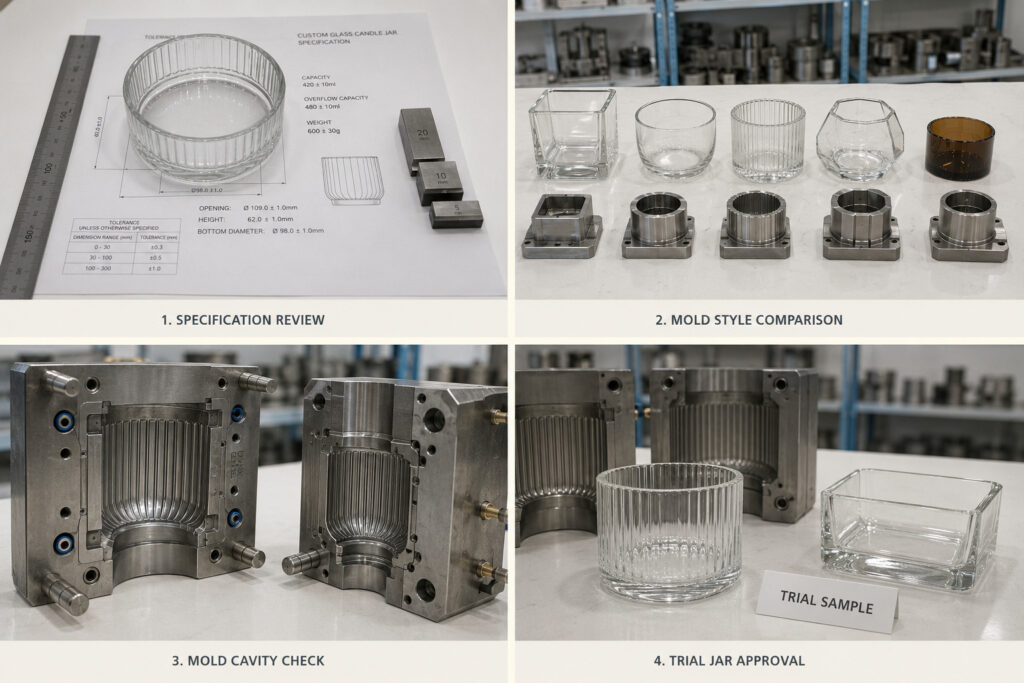 Mold Feasibility and Tooling Review
Glavique reviews the proposed jar geometry against glass-forming requirements, mold construction, dimensional tolerances and expected production volume. Shapes with sharp transitions, very narrow openings, unusual bases or complex surface patterns may require design adjustment before tooling.
The tooling quotation is confirmed after the main dimensions and structure have been reviewed. Tooling cost, development time and MOQ depend on the jar geometry, number of mold components, trial requirements and expected production scale.
A custom mold project should not move directly from a visual rendering into bulk production. The tooling route normally includes drawing confirmation, mold preparation, trial forming, sample inspection and pre-production approval.
More information about how the jar is formed is available on the glass forming and mold production page.
Trial Samples and Dimensional Inspection
Trial samples are checked against the approved drawing and agreed product requirements. Inspection normally covers overall height, outside diameter, opening, bottom diameter, capacity, jar weight where specified, rim condition, base stability and visible forming defects.
Lid fit must be checked with the actual lid and sealing ring. A jar that is within its outside-diameter tolerance may still require adjustment if the opening or contact area does not provide the expected fit.
The first sample may require correction before final approval. Trial-mold timing is therefore evaluated separately from the standard 7–15-day customized sample range.
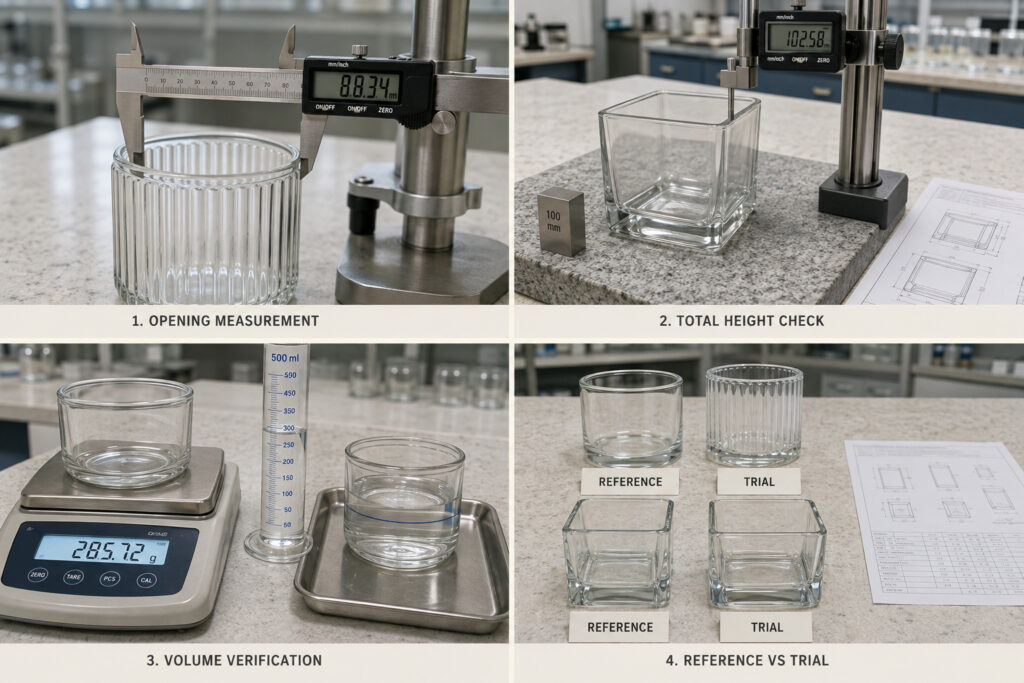 Pre-Production Approval and Bulk Manufacturing
The approved physical sample becomes the production reference for dimensions, appearance and lid fit. Color, logo and packaging can then be developed around the confirmed jar structure through the wider Custom & OEM process.
New mold projects usually require a higher MOQ than standard existing-mold orders. Final MOQ and lead time are confirmed according to the jar design, tooling route, finish, decoration, lid, packaging and quantity per SKU. Complex finishes or new mold projects may require approximately 35–45 days for bulk production after approval.
Information Required for a Mold Development Quote
For evaluation, send:
- Drawing, reference image or physical sample
- Target capacity and complete dimensions
- Preferred opening and lid
- Estimated order quantity
- Surface finish and logo requirements
- Packaging requirements
- Destination and required delivery date
Glavique can then confirm whether an existing jar is suitable or whether new tooling is required, together with the expected sampling route, inspection points, MOQ and production schedule.